
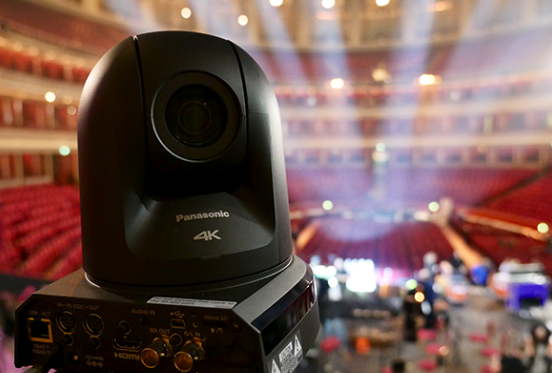
A lot of people have heard the term “PTZ” or “PTZ Camera” without realizing what they are. Knowing what they are is imperative before employing them in your production! So, let’s talk about it…
PTZ stands for Pan, Tilt, and Zoom. Unlike a traditional broadcast camera that’s man-operated, a PTZ is controlled remotely, and a robo camera operator can adjust the camera from a control room without having to actually touch the camera itself. Moreover, a single skilled robo camera operator can control up to four PTZs simultaneously making them cost efficient, but clients and production crews need to discuss if these are the correct tools to reach production objectives.
Not only can PTZ be referring to the literal camera itself, but there are also PTZ platforms to be utilized. A platform essentially allows any camera to be mounted onto the platform and function as a PTZ.
To give a few examples, PTZs can be found mounted in arenas, concert venues, studios, conference spaces, and more and are an incredibly useful tool in modern live production; however, they’re not designed to replace every traditional camera. Since these cameras are stationary, PTZs truly shine when the need is for a camera to stay in one location while still allowing robo cam operators to make adjustments as presenters move or performers walk across a stage.
At Atomic Television, PTZs are one of the many tools we use to build a production that aligns with the vision and goals of each client.
Sometimes, PTZs are the perfect solution. Other times, a traditional camera crew delivers the flexibility the production needs. The best productions are about choosing the best combination of tools to create the best possible broadcast, and PTZs may absolutely be a part of the package you need.
Additionally, robotic pedestals represent the next evolution beyond the standard PTZ cameras. While they provide pan, tilt, and zoom functions, they also add the capability of movement like height adjustments and floor mobility. Robotic pedestals cost exponentially more than a standard PTZ, but they are ideal for highly controlled studio environments, such as local news broadcast sets. Atomic Television partners with leading industry providers of robotic pedestals to integrate them for clients if they align with workflow needs.
Check out our next blog that contains a full logic tree to help you decide if PTZ cameras are right for your next event. Check out “Is Cost Cutting with PTZ cameras worth it?”



PTZ stands for Pan, Tilt, and Zoom. A PTZ camera is remotely controlled to pan left and right, tilt up and down, and zoom in and out without a camera operator physically standing behind it.
PTZ cameras are commonly used for live broadcasts, concerts, sporting events, corporate meetings, conventions, and studio productions. They are especially useful for positions where a camera operator cannot be placed due to line-of-sight issues or hazardous conditions.
Yes! One robo camera operator can control 4 PTZs simultaneously on average. This can help reduce staffing requirements while still capturing multiple angles.
Not necessarily. PTZ cameras excel in fixed positions and controlled environments. Traditional broadcast cameras allow for more flexibility and dynamic movement. Many professional productions use both to achieve the best results.
The number needed depends on the size and complexity of the event. Smaller productions may only need one or two PTZs while larger productions may require multiple PTZs combined with traditional camera operators to capture all of the important angles. Give Atomic Television a call to discuss your specific events needs.