





Broadcast Production Trucks
Based in: Las Vegas, Nevada
Service Area: Las Vegas & the Southwestern United States
Production Type: On-site broadcast truck production
Mobile Units: Neutron & Proton broadcast production trucks
Capabilities: Multi-camera live switching (HD/4K), broadcast audio mixing, replay, ISO recording, graphics, and encoding
Best For: Live sports, concerts, national broadcasts, and high-stakes live events
Crew: Fully staffed broadcast crews available, including directors, technical directors, camera operators, audio engineers, replay operators, and engineering
When a Broadcast Truck Is the Right Choice
A broadcast production truck is used when the production must be controlled on-site and cannot rely on remote workflows. This approach is common for live events where timing, redundancy, and direct access to equipment are critical.
Broadcast truck production is typically used for:
Live sports broadcasts
Concerts and large-scale live events
National or regional network productions
Events with zero tolerance for failure
Multi-camera shows that require replay and graphics
Productions that need on-site engineering and signal control
If the show is live, complex, or high-risk, on-site broadcast truck production is usually the safest option.
Atomic Television Broadcast Production Trucks
- What Can Be Included
- Professional crew available (TD, A1, Shader, Replay, etc.)
- Full setup & strike
- Intercom, scopes, waveforms, audio routing
- 4K or HD configurations
- Internation Feeds
- Pre/Post Deck
- REMI-compatible
- Can integrate with your switcher or graphics package if needed
Atomic Television Broadcast Production Trucks
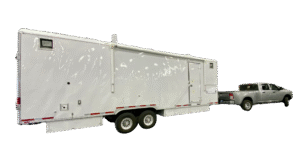
- "Proton" HD Production Trailer
- Dedicated stations for Switcher, Audio, Replay, Graphics & Engineering
- Air-conditioned & crew-comfort designed
- Fully outfitted for multi-camera broadcast
- Compatible with REMI & hybrid workflows
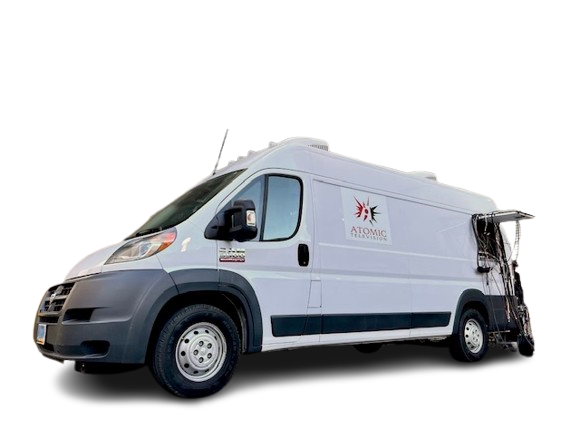
- "Neutron" 4K OB Van
- Dedicated stations for Switcher, Audio, Replay, Graphics & Engineering
- Sporting Events
- Fully outfitted for multi-camera broadcast
- Compatible with REMI & hybrid workflows
















Our Expert Answers
What is a mobile broadcast production truck and how is it used for live events?
A mobile broadcast production truck is a self-contained, high-definition control room on wheels designed to capture, switch, and transmit multi-camera live video feeds from any location. These units serve as the technical nerve center for trade shows, sports, and corporate keynotes, providing the processing power and signal reliability required for network-standard broadcasts.
Key components of a mobile multi-cam production setup include:
● Production Switcher: The hardware (like Ross Carbonite) used to cut between various camera angles in real-time.
● Engineering Station: A centralized hub for monitoring signal integrity and "shading" cameras for color consistency.
● Audio Console: A dedicated mixing board (like the Yamaha QL series) for managing complex microphone and playback routing.
● Slow-Motion Replay: Specialized servers used to capture and play back highlights during live action.
● Encoder Racks: Hardware that compresses video for transmission via satellite, fiber, or bonded cellular.
Atomic Television offers a specialized fleet, including our ultra-compact Proton and Neutron trailers. Because we are based in Las Vegas, our trucks are specifically outfitted to navigate the narrow loading docks of the Mandalay Bay and Caesars Forum, offering a "plug-and-play" solution that out-of-state competitors simply cannot match.
What is the difference between a full-size broadcast truck and a compact production trailer for event coverage?
The primary difference lies in the footprint and "crew capacity," where full-size trucks offer expansive climate-controlled environments for large teams, while compact trailers provide high-end broadcast capabilities in a smaller, more maneuverable form factor. Choosing between them depends on the geographic constraints of your venue and the complexity of your production's technical requirements.
When comparing production mobile units, consider these factors:
● Crew Seats: Full trucks accommodate 10+ operators; compact units are optimized for 3–5 specialized roles.
● Power Requirements: Large units often require 100-200 amp 3-phase power; compact trailers can often run on standard shore power.
● Equipment Density: Compact units focus on "REMI" or remote workflows to save space.
● Maneuverability: Smaller units can fit inside convention halls or on rooftop parking structures.
Atomic Television provides our Proton and Neutron trailers, which are the only units of their kind in Las Vegas designed to deliver Ross Carbonite switching and Sony 4K camera chains within a footprint small enough for an indoor booth activation. This allows us to bring a "broadcast control room" directly onto the LVCC floor, eliminating the need for 500-foot cable runs back to a traditional loading dock.
What is REMI remote production and how does it reduce live event costs?
REMI (Remote Integration Model) is a production workflow where video and audio signals are captured on-site and transmitted over the internet to be switched by a director at a different geographic location. This model significantly reduces travel costs and onsite footprints by allowing the bulk of the production crew to work from a centralized home studio.
The technical components of a REMI-enabled truck include:
● Low-Latency Encoders: Hardware like Haivision or Teradek that sends signals with sub-second delay.
● Bonded Cellular/Fiber: Multiple internet paths to ensure the stream never drops.
● Return Video (IFB): A "talk-back" system so the director can speak to the onsite camera operators.
● Synchronized Clocks: Ensuring all camera feeds stay in perfect "genlock" over the public internet.
Atomic Television’s Proton unit is specifically engineered for this workflow, utilizing redundant fiber backhauls from major Las Vegas venues. By using our local trailers as "on-ramps" to the cloud, we provide a fail-safe transmission hub that standard fly-pack systems cannot guarantee during high-traffic events like CES or NAB.
Is it better to use a broadcast truck or a portable fly-pack for a convention center event?
A broadcast truck is a pre-integrated, climate-controlled environment that arrives ready to work, whereas a fly-pack consists of modular equipment racks that must be painstakingly assembled and wired on-site. While fly-packs are useful for "deep interior" rooms, a truck offers a more stable and efficient engineering environment for mission-critical broadcasts.
Key comparison points include:
● Setup Time: Trucks are "show-ready" in under an hour; fly-packs can take a full day to "cable-up."
● Reliability: Trucks feature permanent, vibration-tested wiring that is less prone to "hand-off" errors.
● Operator Comfort: Climate-controlled trucks prevent equipment overheating and crew fatigue.
● Monitoring: Trucks offer larger, professional-grade multiviewer walls for the director.
Atomic Television offers compact mobile units that act like fly-packs but function like trucks. Our Neutron unit can be pushed directly into a ballroom or onto a freight elevator, giving you the Sony 4K image quality and stable engineering of a broadcast truck with the unmatched versatility of a portable system, specifically tailored for the massive scale of the Las Vegas Strip.
How do broadcast trucks ensure a stable live stream for global corporate events?
Broadcast trucks ensure stream stability by utilizing dedicated hardware encoders and multiple "redundant" transmission paths—such as satellite, dedicated fiber, and bonded cellular—to bypass unreliable public Wi-Fi. This creates a hardened signal path that guarantees your keynote or product launch reaches a global audience without buffering or resolution drops.
Transmission components found in our mobile units include:
● Hardware Encoders: Dedicated appliances (not laptops) that handle 4K H.264 or HEVC encoding.
● Satellite Uplink: A "last resort" signal path that doesn't rely on local internet infrastructure.
● Network Managed Switches: Enterprise-grade hardware to prioritize video traffic.
● Point-to-Point Fiber: Direct connections to global CDN (Content Delivery Network) ingest points.
Atomic Television has strategic partnerships with local Las Vegas data providers. Our trucks, such as the Atomic B-Unit, are equipped to interface directly with the dark fiber networks at the LVCC and Venetian Expo. This allows us to provide a 10Gbps signal backbone, ensuring that your live stream has more bandwidth and security than any standard AV provider in the city can offer.
What specialized crew members are required to operate a broadcast production truck?
Operating a broadcast truck requires a specialized team of engineers and creative professionals who are trained to manage high-bandwidth signal matrices and real-time television switching. Unlike general stagehands, "truck-vetted" personnel understand the interconnectivity of broadcast hardware and can troubleshoot complex technical issues under the pressure of a live countdown.
Standard crew roles for a mobile unit include:
● Engineer in Charge (EIC): The lead technician responsible for the truck’s overall health and signal routing.
● Technical Director (TD): The "hands-on" operator who executes shots on the Ross Carbonite switcher.
● V1 (Video Engineer): Responsible for "shading" cameras to ensure uniform color and exposure.
● A1 (Lead Audio): Manages the broadcast mix, including wireless mics and remote guests.
We have a roster of Vegas-local A-list crews who are intimately familiar with the Atomic fleet. Because our team works on the Atomic trucks year-round, they possess a "home-court advantage" in Las Vegas venues. This means our EICs know exactly where the power drops are in every major ballroom, ensuring your production is faster, safer, and more professional than a team traveling from out of state.